Store and document data with Opal
OBiBa's core data management application, to import, transform, describe and analyze data.
What is Opal?
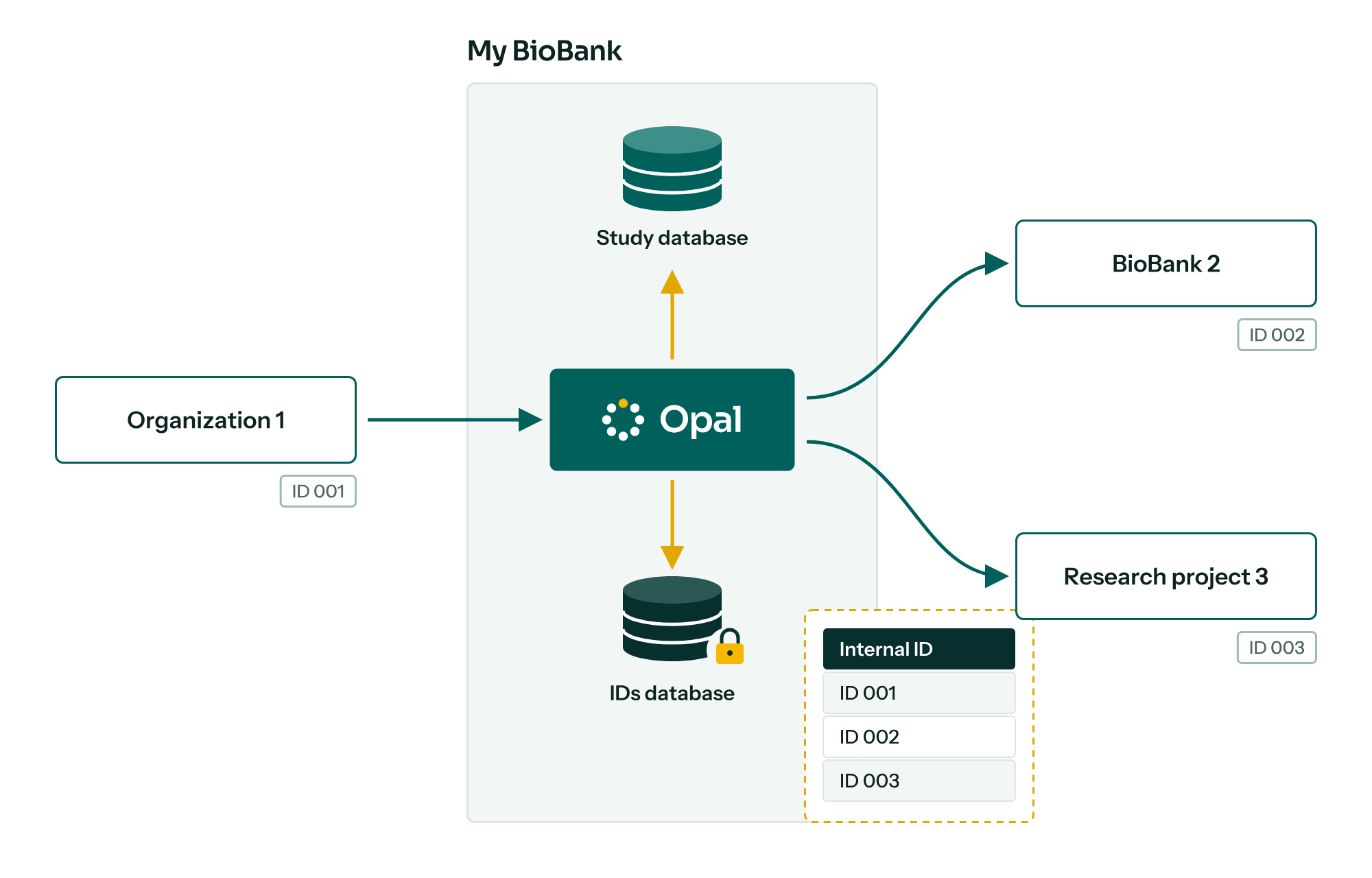
Opal is OBiBa’s core data management application. This server application provides all the necessary tools to import, transform, describe and share data. Participant identifiers are kept apart from the data and managed at import and export time.
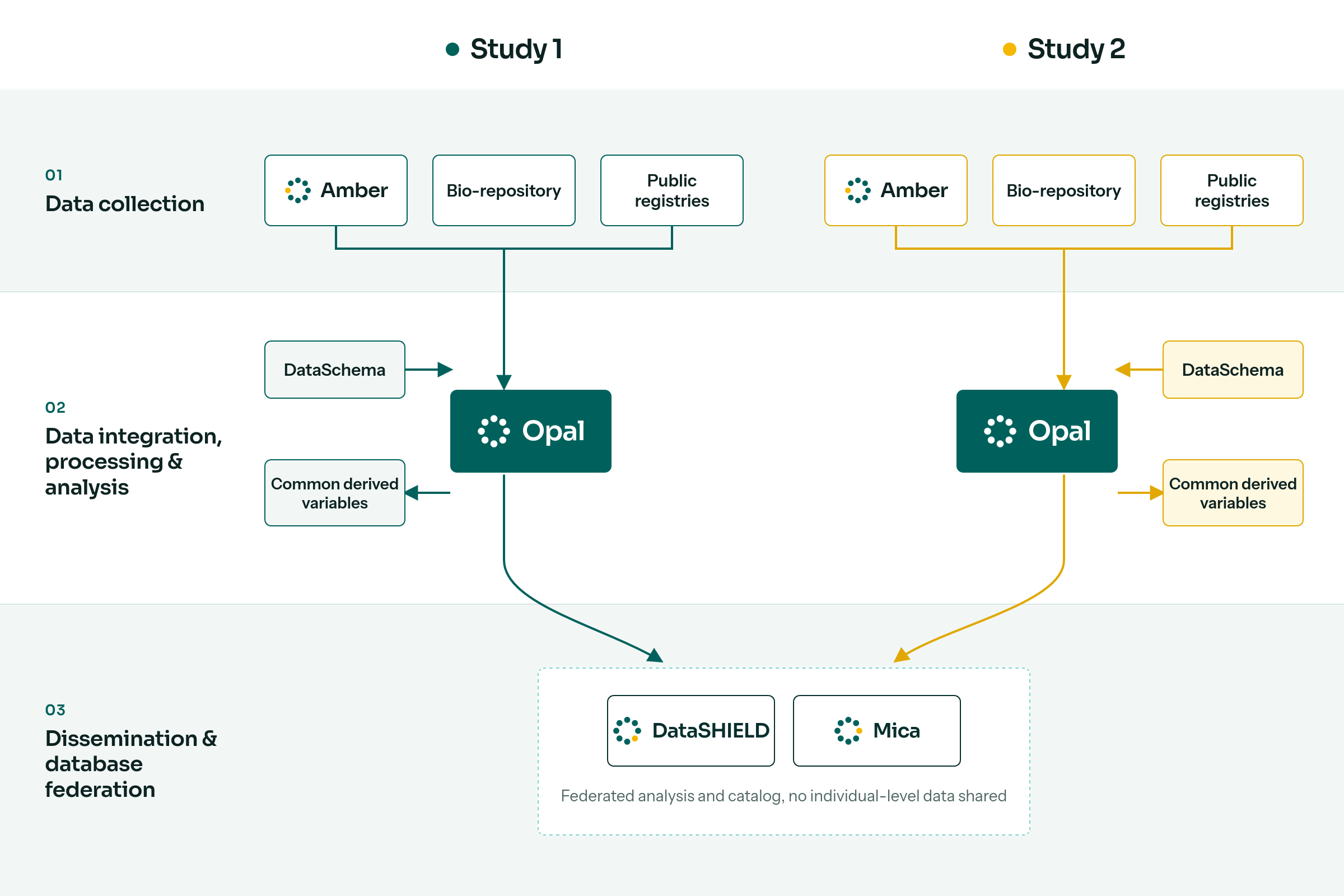
Analysis. Thanks to its integration with R, complex statistical analysis and reports can be performed. The implementation of DataSHIELD allows advanced statistical analysis across multiple studies without sharing or disclosing any individual-level data.
Integration. Studies using Opal can import data collected with Amber directly from the Amber server, and build web data portals with Mica that query Opal for real-time aggregated reports. Secured REST web services allow automating server management and accessing data from R, Python or any web-capable tool.
Features
Data warehouse.
- Projects hold tables of any entity type (participant, sample, instrument…) and value type, including dates, binaries and geographic points, lines and polygons.
- Data are stored in MySQL, MariaDB, PostgreSQL or MongoDB. A project can also be created with its own database, managed by Opal.
- Import from CSV, SPSS, SAS, Stata, Excel, SQL, REDCap, LimeSurvey, Amber or another Opal server; incremental imports; export to CSV, Opal archive or SQL.
- Query tables with SQL through the web services, and look an entity up across tables.
Data dictionary and harmonization.
- Variables with categories and multilingual attributes, annotated with taxonomies such as the Maelstrom Research classification.
- Views: virtual tables of derived variables, with a JavaScript derivation library, user-friendly recoding, versioned scripts and instant summary statistics.
- Full text variable search across projects.
Resources. Give R/DataSHIELD sessions access to remote big or complex datasets and computing units without importing data: only the location and credentials are stored. See the resourcer R package.
R and DataSHIELD.
- Computations are delegated to Rock R servers, that can be clustered for load balancing and declined in profiles (different R versions and packages).
- DataSHIELD packages, allowed methods and options are managed per profile, with usage quotas, audit and metrics.
- R Markdown reports and analysis plugins (data validation) run on the R server.
Privacy, confidentiality and security.
- Multiple identifiers per participant, kept in a database distinct from the data; data imported or exported with a research project’s own identifiers.
- Password, certificate, personal access token, OpenID Connect, LDAP/Active Directory and Agate authentication; two-factor authentication.
- Permissions down to the variable level, summary statistics privacy threshold, PKI-based data encryption.
Administration. Centralized file system with access controls and SFTP, plugins (search, data sources, VCF genotypes store, analysis), persistent task history, storage safeguards, and OpenTelemetry export of logs, traces and metrics.
Download
Opal is a stand-alone Java web server application.
- System packages
- Debian / Ubuntu: use the Debian package repository.
- Fedora / RHEL: use the RPM package repository.
- Other platforms: download the zip distribution from the GitHub releases.
- Containers
- Docker: use image from Docker hub repository
- Helm charts: use OBiBa Helm charts
See the installation guide and the configuration guide.
Try Opal
Have a look at the demo site with one of these credentials:
- Administrator:
administrator/password - DataSHIELD users:
dsuser,dsuser1,dsuser2,dsuser3/P@ssw0rd
Opal releases
- opalImport from Amber, geo variable summaries, persistent tasks, file content viewer
- opalNew configuration database, project-internal databases, DataSHIELD quotas, OpenTelemetry
- opalFile bundle support, security improvements
- opalMaintenance, security improvements
- opalAPI documentation, User info tracking, security improvements